The Successful Implementation That Quietly Failed
March 12, 2026
Most private markets firms have deployed portfolio monitoring platforms and are not capturing the expected value. The reason is almost never the technology.
Key Takeaways
- Most implementations are declared successes by delivery metrics, yet within 18 months most firms are running parallel manual processes alongside their live platform.
- Four structural forces: AUM scale, LP data requirements (ILPA, SFDR), Semi Liquid/Evergreen funds and co-investment obligations, have made platform capability a precondition for raising capital, not merely an efficiency tool.
- Platforms fail silently through a three-stage cycle: static AI parsing configurations degrade, ungoverned data models lose consistency, and adoption stalls outside the core operations team.
- The firms that close the gap share one decision: they treat portfolio monitoring as a continuous operational function, not a completed project.
- Governance, escalation, and configuration management must be held onshore, close to the investment team. Volume tasks can scale offshore. Conflating the two consistently causes governance to degrade within two years.
- The right diagnostic: if your largest LP requested a complete data room tomorrow, how long would it take, and how confident would you be in every figure?
A $40 billion private equity firm implemented a portfolio monitoring platform eighteen months before its anchor LP — a pension fund in the first year of a re-up decision — requested a complete data package: quarterly financials for every portfolio company, ESG data traceable to source documentation, auditable valuation lineage, and co-investment reporting on fund timelines. The operations team’s answer: three weeks, confidence not high.
This is not an edge case. Across our implementation assessments covering more than 40 private markets managers and $14 trillion in AUM, we encounter it consistently. Platforms are live. Implementations were declared successes. The capability they were meant to create is not there.
Deployment Is Not Capability
Implementations are assessed on delivery metrics: on time, on budget, data migrated, system live. These are the right metrics for a project. They are the wrong metrics for a capability — they measure the handover, not the ongoing performance of the system in production. What follows a successful go-live, consistently, is predictable decay. Parsing configurations go uncalibrated as portfolio company reporting formats evolve. Governance frameworks, written as deliverables, are not operationalized as living processes. Adoption stalls outside the core operations team.
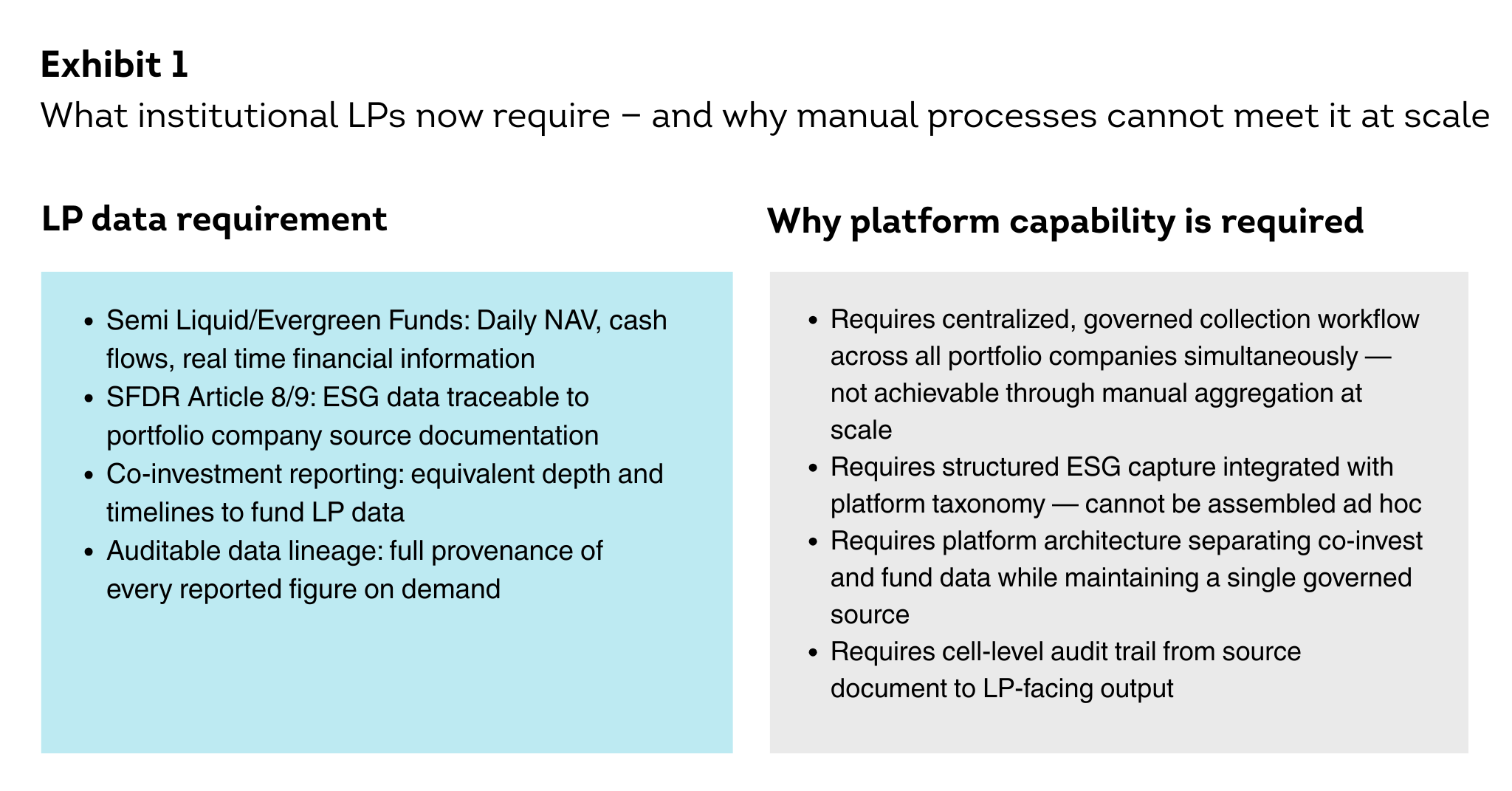
This cost does not appear as a line item, but it surfaces at the moments that matter most. Firms without governed platform capability are increasingly locked out of entire categories of capital: institutional LPs whose data standards manual processes cannot meet, semi-liquid and evergreen structures whose reporting cadence closed-end workflows cannot support, and co-investment mandates that demand data confidence on timelines that leave no room for reconciliation. Platform capability now defines the boundaries of a manager’s addressable market.
The Pressure Is No Longer Optional
Four structural shifts have moved portfolio monitoring capability from a competitive differentiator to something closer to a license to operate in institutional capital markets.
Scale. Private markets AUM grew from approximately $7 trillion in 2015 to more than $12 trillion today — an increase of roughly 70% in a decade without proportional growth in operational headcount. Managers have absorbed that growth by extending platforms and processes designed for smaller portfolios. Where those platforms are ungoverned, the inefficiency has compounded across more portfolio companies, more reporting relationships, and more demanding investors simultaneously.
Semi Liquid/Evergreen Funds. The growth of continuously offered fund structures has introduced a reporting cadence that closed-end infrastructure was never designed to support. Where traditional funds report quarterly, semi-liquid and evergreen vehicles require near-continuous NAV calculation, accelerated valuation cycles, and investor-level reporting on redemption timelines that compress the operational window to days rather than weeks.
Co-investment. Co-investors now expect data visibility equivalent to fund investors on the same timelines, as a matter of course. For managers whose data infrastructure was not designed to serve co-investment reporting separately, meeting this requirement means significant manual effort at every cycle — or investing in the kind of governed platform architecture that makes it systematic.
Regulation. SFDR Articles 8 and 9 require ESG data at portfolio company level, traceable to source documentation, as a condition of fund classification. ILPA data standards, now baseline LP expectations across North America and Europe, mandate quarterly cash flows, fees, and NAV at both fund and investment level. These are threshold requirements for accessing institutional capital.
Why Platforms Fail Silently
The failure to capture value from portfolio monitoring platforms is not random. Across our implementation assessments, the same three root causes appear consistently, in the same sequence, with predictable consequences for platform health over time.
Configuration treated as permanent
Portfolio monitoring platforms require continuous maintenance to remain accurate. Formula logic, global labels, taxonomy, and data mappings must evolve as the portfolio grows and companies change how they report. Implementations that treat initial configuration as a completed deliverable find data integrity eroding quietly across reporting cycles — and the teams consuming outputs becoming progressively less confident in what they are reading.
Governance written but not operated
Data governance frameworks are almost universally produced as implementation deliverables. They are rarely operationalized as living processes. Without active governance, the data model accumulates inconsistencies as new assets are configured differently, data definitions drift across teams, and model changes are made without coordination. The result is a platform that no team fully trusts as a single source of truth. Recovering from this state typically requires remediation comparable in scope to a re-implementation.
Adoption that stalls at the implementation team
Platform value reaches decision-makers only when they can self-serve. As implementation teams rotate off and new staff join the organization, the proportion of users with the knowledge and confidence to self-serve declines — and the platform’s most significant value proposition reverts to a model where a small group of power users fields requests from a larger group of non-users.
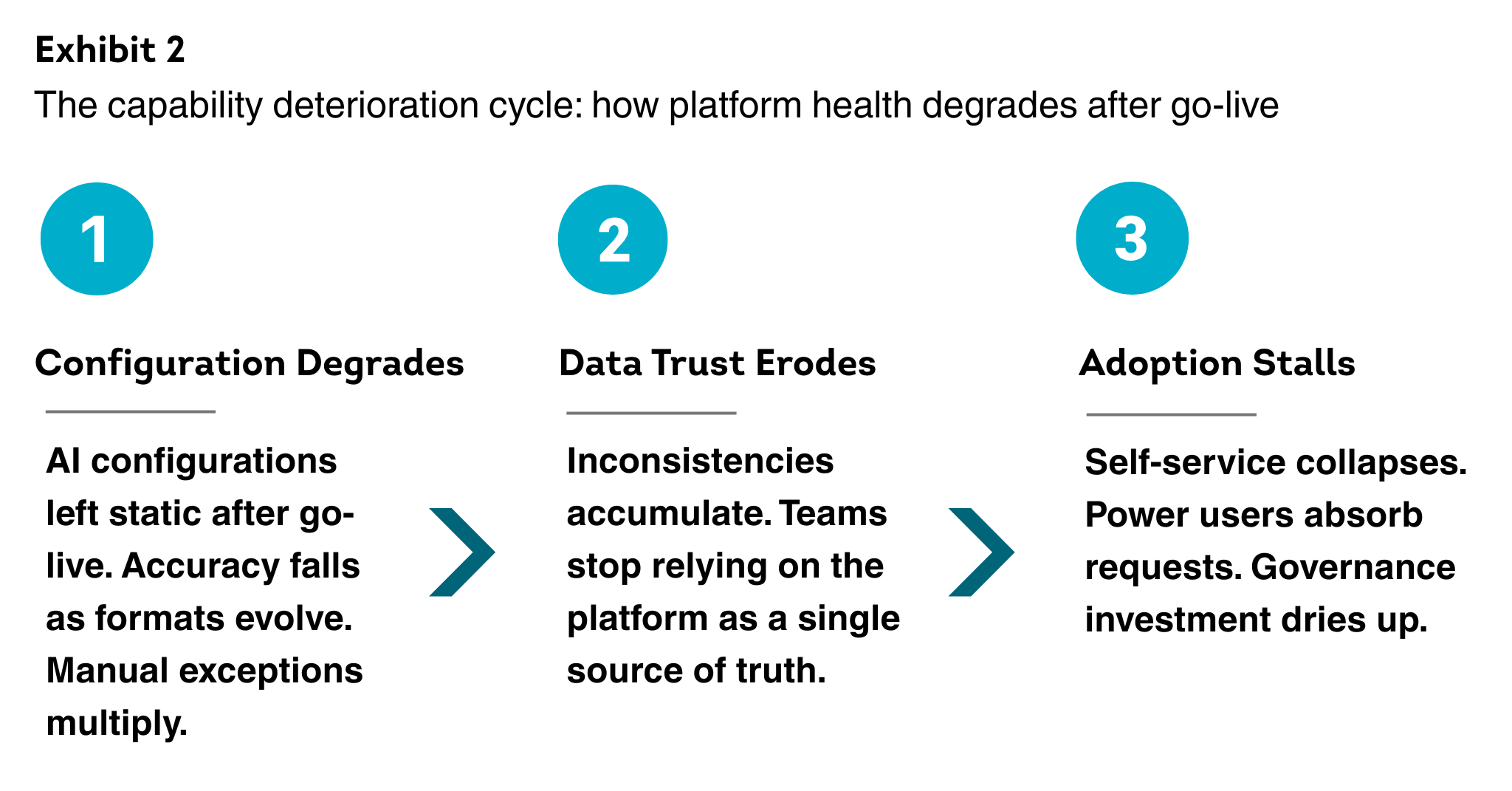
Each stage feeds the next — and the loop repeats. Platforms deteriorate not through crisis, but through compounding invisible erosion.
What the Leaders Do Differently
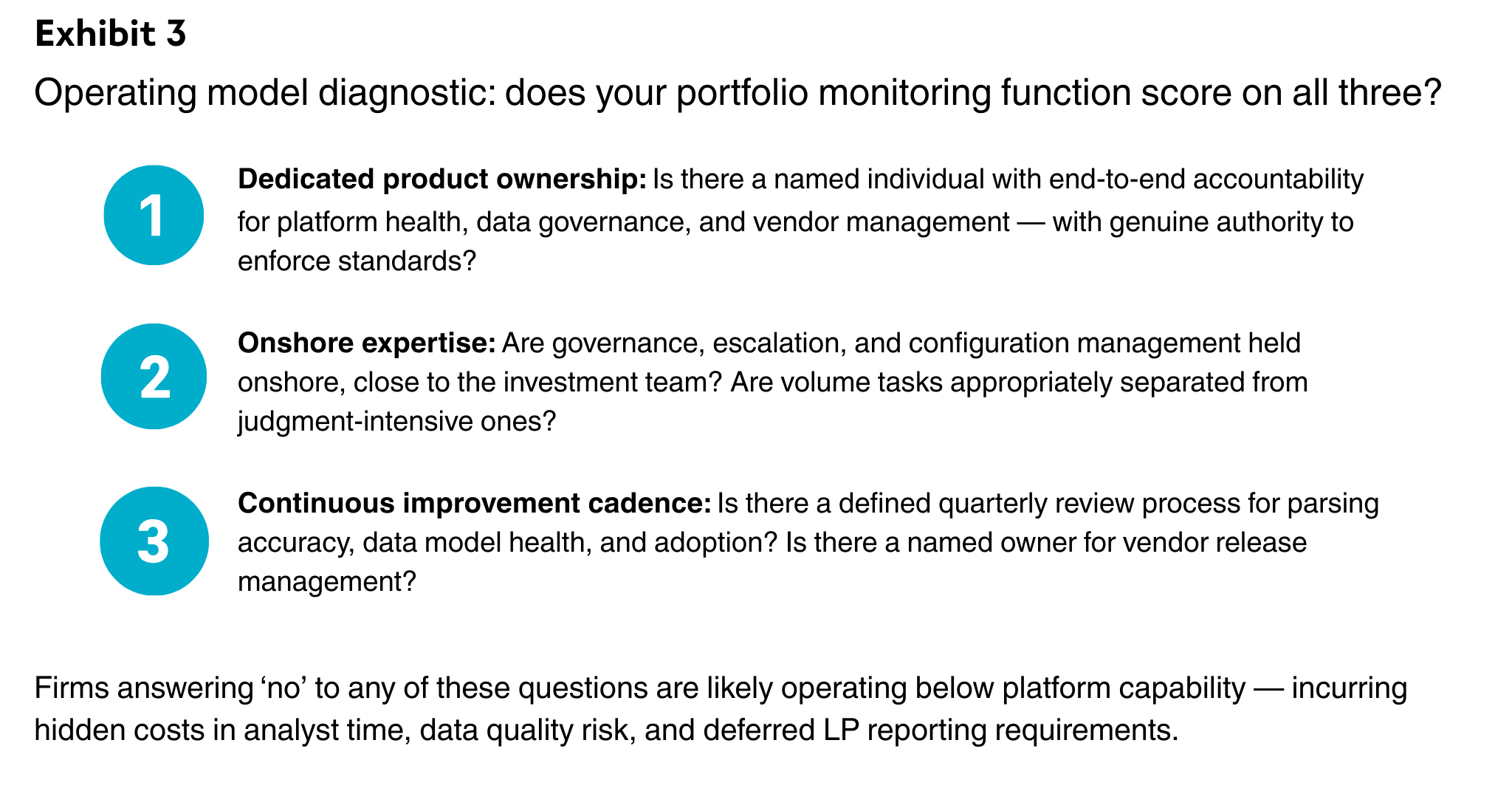
The firms that have successfully closed the capability gap are not distinguished by platform choice, implementation quality, or technology budget. Analysis of operating models at leading private markets managers across private equity, private credit, real estate, and infrastructure in the $5bn to $1Tn AUM range identifies three characteristics shared by the top quartile of platform utilization.
A dedicated owner with real authority
In every high-performing operating model we have examined, a named individual — a product owner, platform lead, or data operations manager — holds end-to-end accountability for platform health. This person owns the data governance framework, manages the AI parsing configuration as a living system, controls changes to the data model, manages the vendor relationship, and serves as the escalation point for data quality issues across the organization. The product owner in these firms has genuine operational authority: the ability to block data model changes that lack governance sign-off and to reject asset onboardings that do not meet data quality standards. Where that authority is nominal, governance degrades rapidly under the routine pressure of competing operational priorities.
Onshore expertise, close to the investment team
The responsibilities that determine whether a platform capability holds — data governance, parsing calibration, model change management, real-time escalation during quarter-end close — require same-time zone presence, direct access to deal teams, and contextual knowledge of the firm’s specific data model and investment thesis. These are not tasks that can be effectively delegated to a team in a different time zone rotating through client engagements.
This does not mean all portfolio monitoring functions must be onshore. High-volume, lower-complexity tasks — initial document extraction from standardized formats, routine data quality checks — can be effectively supported by offshore or near-shore capacity, and leading firms use it for exactly this purpose. Firms that conflate these categories and manage governance remotely consistently see it degrade within two years of implementation.
A continuous improvement cadence
The firms operating at top-quartile platform utilization treat their portfolio monitoring configuration as a product under active development, not an installation that is complete. They run quarterly reviews of parsing accuracy, with recalibration triggered whenever exception rates exceed a defined threshold. They operate structured change management for data model updates, with governance committee review and documented impact assessments.
The Staffing Decision Most Firms Get Wrong
Having established what the operating model requires, the strategic question becomes: how do you build and sustain this capability most cost-effectively? Three options exist, each with a distinct cost structure and risk profile.
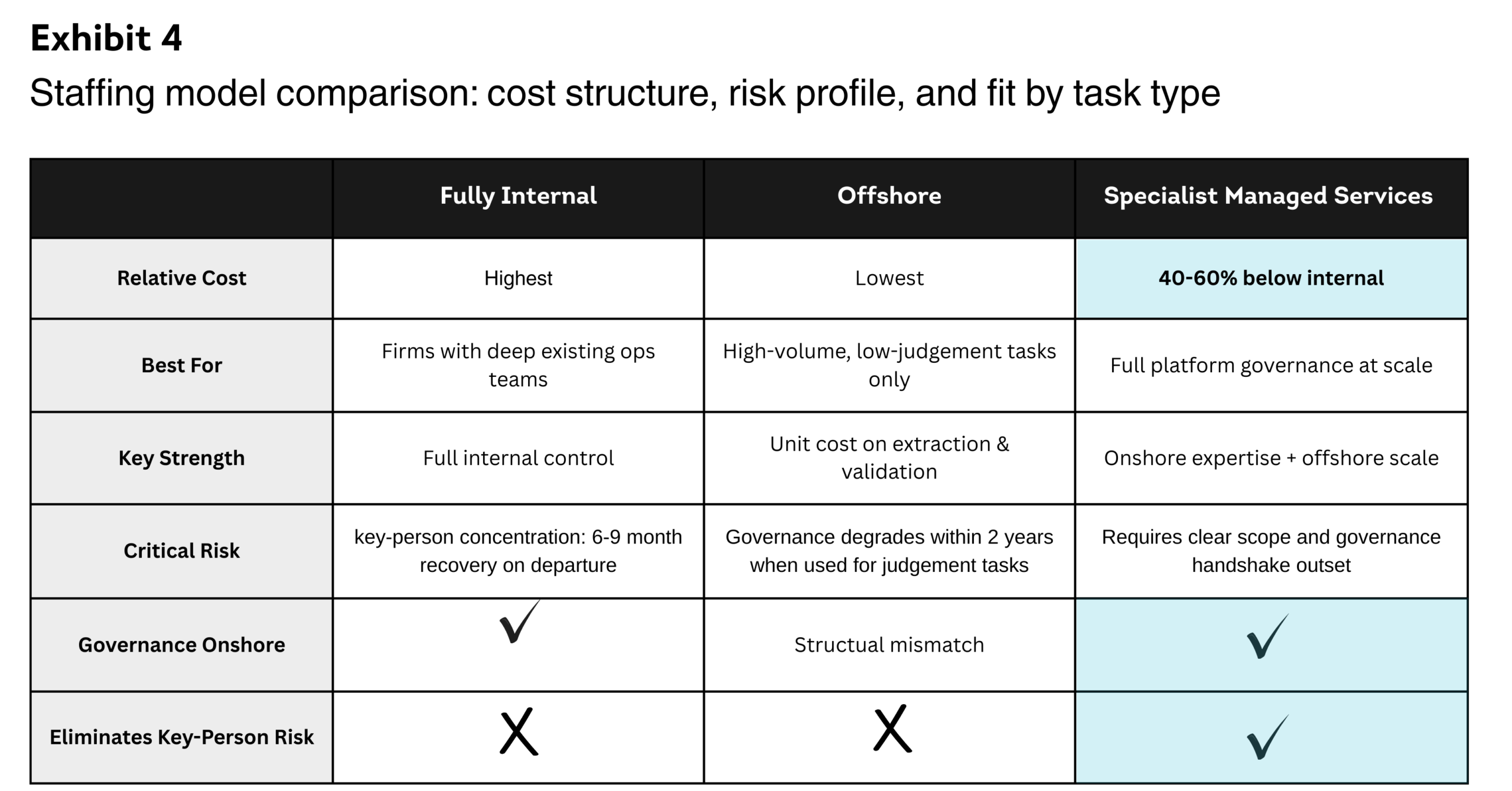
The build-or-partner decision is not a function of cost alone. It is a function of whether your organization can staff, retain, and develop the specialist expertise required to operate this capability at full performance — and what the consequences of a capability gap are given your LP base, regulatory obligations, and competitive position.
Four Actions for Private Markets Leaders
-
Conduct an honest capability assessment before your next fundraise.
Apply the three-characteristic diagnostic above to your current platform operating model — not the implementation team’s go-live assessment. Assess the current state of parsing accuracy, data model consistency, adoption breadth, and governance operationalization. The gap between implementation success and operational capability is typically more significant than firms expect.
-
Establish named accountability before attempting any optimization.
Platform optimization initiatives consistently underdeliver when accountability is distributed. Before investing in new configurations, integrations, or capability extensions, establish a named product owner with clear authority over data governance and platform configuration. Without this, improvements made in one quarter are typically eroded within two reporting cycles by ungoverned changes elsewhere in the system.
-
Separate judgment-intensive from volume tasks in your operating model.
Not all portfolio monitoring tasks require the same type of resource. Governance, escalation, and configuration management require contextual expertise and onshore proximity. Document extraction, routine data validation, and standard reporting production can often be performed at significantly lower cost by appropriately managed offshore teams. Designing the operating model around this distinction typically reduces the cost of the function by 40 to 60 percent without sacrificing the quality of the outputs that matter most.
-
Treat platform investment as a continuous program, not a completed project.
Establish quarterly reviews of parsing accuracy, adoption metrics, and data model health as standing operational processes. Assign a named owner for vendor release management. Budget for ongoing configuration management, not just annual license costs. Sustained progress on capability maturity comes not from large discrete investments but from disciplined, continuous attention to platform health.
About this research
Findings draw on portfolio monitoring implementation assessments and operating model analyses conducted across more than 40 private markets managers — spanning private equity, private credit, real estate, and infrastructure, with combined AUM exceeding $14 trillion — across North America, Europe, and Asia-Pacific. Managers assessed ranged from $5bn to $1Tn AUM. All firm-level data has been anonymized.
Contact us today
To discuss these findings in the context of your firm’s portfolio monitoring operating model, contact David Hess at david.hess@alphafmc.com.